
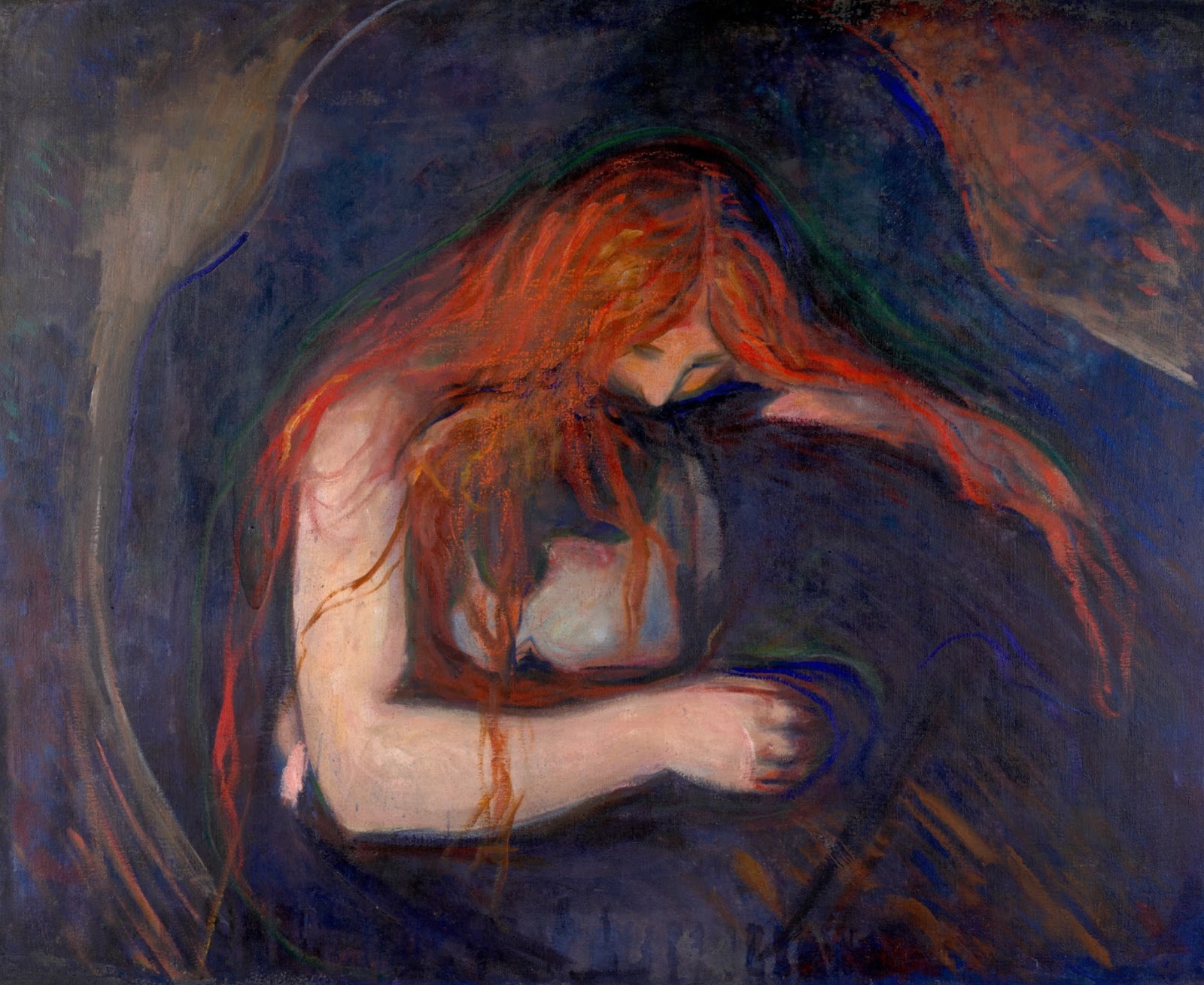
Edvard Munch – Vampire (1895)
At the start of my fourth year of medical school, I arrived at the hospital uncaffeinated, hungry, thirsty, and slightly irritable. I was about to embark on my dedicated study period for Step 2, but first I needed to care for someone I had been ignoring—myself. That brought me back to the same location where I had completed my final surgery rotation. This time, I was a patient rather than a student.
After sitting in the waiting area, I left my grandmother behind while they brought me up to pre-op. I was nervous for the procedure but more anxious to avoid running into classmates or familiar faces. Then it came time to draw blood.
I have notoriously small and difficult veins. Though I have no fear of needles, every time I need labs I pray to the god of blood vessels to favor me with a clever phlebotomist. Usually I can set myself up for success with a Gatorade and a heating pack straight to the antecubital fossa, but this time I had no options.
I knew that my dehydrated, fasted state would be a problem, but I didn’t want to be one. So when the nurse started palpating and decided to try for a vein in my hand, I held back a protest. Hand IVs can be very painful and usually don’t work on me anyways. Another nurse asked me her intake questions while the series of pokes began. I tried to keep my eyes off the process but flinched away as I felt the distinctive electric shock of an injured nerve. The nurse gave up, clearly frustrated with me.
“You’re moving too much,” she said, then left.
The second nurse palpated both of my arms and told me she didn’t think it was worth trying. She enlisted the ultrasound IV placement team. When they arrived, I was already tearful, embarrassed, and ready to be unconscious.
–
How many times have you watched a patient cringe as they are poked and prodded, turned and shoved? I have seen women sob into their nurses’ shoulders as multiple attempts at an epidural placement fail. Never once did I hear any of them say, “That’s enough.”
‘Do no harm’ is a vague statement. It is incapable of speaking to these smaller moments where some harm is necessary. The labs must be drawn, the fluids given, the blood sugar checked. Each needle is the mechanism for saving a life or promoting health. Each needle hurts.
In a 2024 randomized controlled trial of adult patients who scored >3 on the Adult-Difficult Venous Catheterization scale, researchers found that US-guided IV was more successful with fewer attempts required and greater patient satisfaction despite similar reported pain to the conventional procedure.1
I would argue that for patients who seem likely to be a difficult stick, it doesn’t matter whether the procedure is ultimately less painful or even if it requires fewer attempts with ultrasound. If we have the time and the resources to identify exactly where their vein is, then we have no reason not to use an ultrasound (or find someone who can). Similarly, whenever there is an opportunity to be more precise or reduce the burden of pain, we should endeavor to do so.
I propose a revision to the Hippocratic oath: When you harm, do it less.
References
1. Salleras-Duran L, Fuentes-Pumarola C, Fontova-Almató A, Roqueta-Vall-Llosera M, Cámara-Liebana D, Ballester-Ferrando D. Pain and Satisfaction Perceptions of Ultrasound-Guided Versus Conventional Peripheral Intravenous Catheterization: A Randomized Controlled Trial. Pain Manag Nurs. 2024;25(1):e37-e44. doi:10.1016/j.pmn.2023.07.010

Sarah Brady is a member of The University of Arizona College of Medicine – Phoenix, Class of 2026. She was born in Georgia, raised in Florida, and currently lives in Arizona. She graduated from Arizona State University with consecutive degrees in English Literature and Biomedical Engineering. She loves to garden and particularly enjoys attempting to grow plants that are entirely unsuited to the Arizona climate.
Image © Ashley Lorraine Baker