
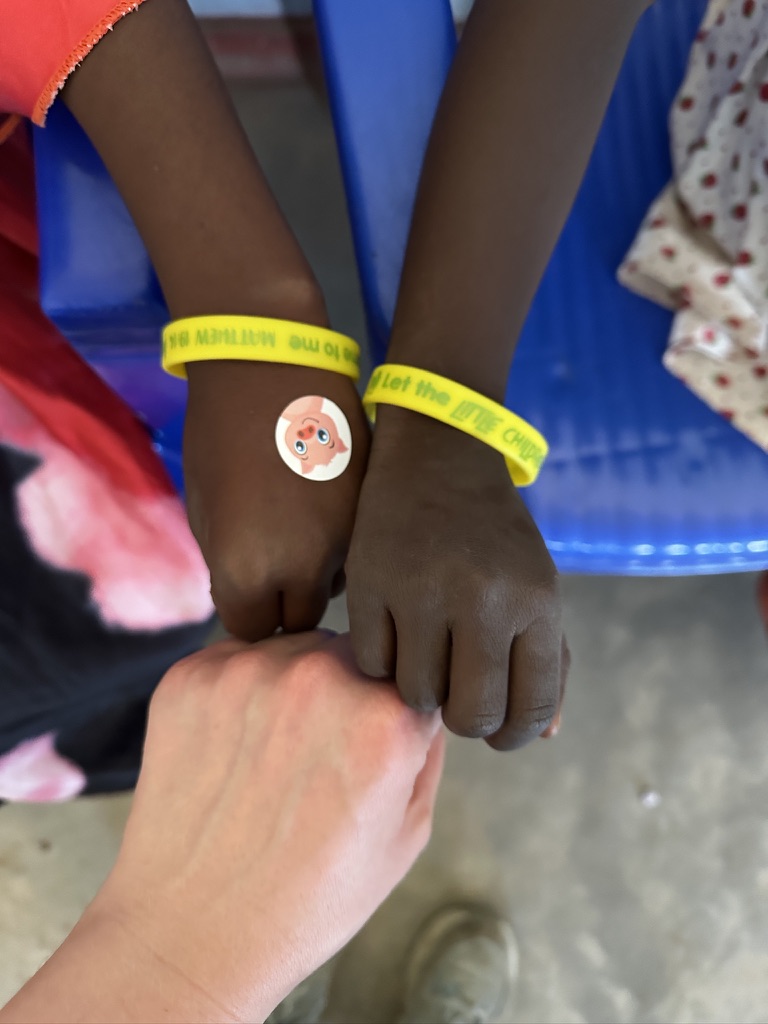
Our first sunset in Malawi was magnificent. If you’ve never seen the sun fall behind the legendary “Mountains Beyond Mountains” that inspired Paul Farmer, I implore you to use your imagination and I regret to inform you that the image you’ve conceived still does not compare to the real thing. The hazy evening light accompanied by the occasional buzzing, potentially infectious mosquito, tickles the soft hair on your arms and sends shivers up your spine. The sky faints away after her long, brilliant day into a sea of maroon, then the pitch-black falls and the air chills.
Earlier that day, 600 women and children stood like dominoes in a line that wound from the steps of the church to the back road where we had parked our bus, toe to heel, waiting on blood tests, physician visits, and medication dispersals. We had shown up anticipating 200-300 orphans and caretakers from our partnering childcare institutions and were entirely impressed and overwhelmed with the sheer numbers of patients who streamed in from nearby villages. Our 4 foreign physicians and 4 Malawian healthcare workers fervently worked to see every patient with the dedication of a small army, while the pharmacy students locked away in our makeshift med room scrambled to locate the correct medications and scribbled hieroglyphic prescriptions in faded ink on paper bags. Hieroglyphics to overcome any potential language barrier, translators to interpret the instructions when parents were present, instructions on paper bags to go back to the caregiver when parents were absent. Nonmedical volunteers sprinted back and forth with messages, equipment, and occasionally, children. Numerous children and young women gathered on and near the dilapidated building-turned-clinic, until we could no longer see the steps leading up to the door. They sat and watched with sleepy eyes, barely rousable enough to make a path for their friends and neighbors to retrieve their own medicines. It was barely late afternoon when the word began to spread, “Get in the bus! We need to make it back before nightfall.”
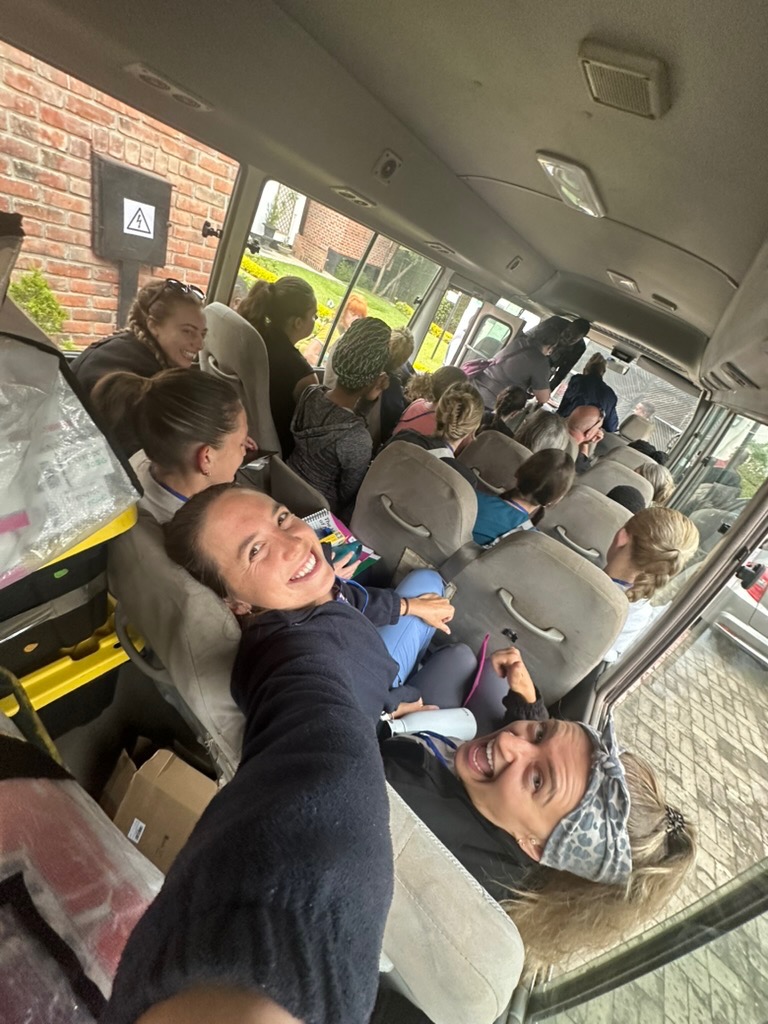
Though we still had 200+ pharmacy prescriptions to fill, our driver and local associates urged us to stop what we were doing and pack up our things. “We can bring back the medications and pass them out tomorrow. Get in the bus. Now.” And so, unfamiliar with the territory, we hustled into the rusting, well-loved school bus with an uneasy urgency and spoke in hushed tones as we watched the sky begin to turn from its bright airy brilliance to every hue of pink and gold. My eyes were glued to the windows. I fought the post-clinic fatigue and held my breath as the last ray of sun dipped below the highest mountain, leaving the geography to its dusty, dusky soft glow. “Mountains Beyond Mountains” echoed between my ears.
Then, the dark fell. It really did fall, too. An unexpectedly abrupt decline of the light left us with visual acuity of 5%, and the 5% was entirely supplied by the lights in front of the bus. Think of Space Mountain in Disneyland, which may have had more ambiance. My retinal rods were exercised as though never before. For the first time, I felt as though my childhood fear of the dark may have been underappreciated by the adults who so cavalierly told me to go back to bed. I’d never seen such widespread darkness. No wonder we were in such a hurry to get home.
It didn’t occur to me until we re-entered the town that the light I had grown so accustomed to throughout my whole life was not normal. In truth, this rural town was a more accurate version of “real life,” without the luxury of electricity to light my way, spaced out appropriately by city planners before I was born. Instead, life continued in the pitch black, dotted with the occasional flare of wealthy fluorescence or cooking fire. A flash of a pink bow was all that revealed a child as she dipped dangerously close to our bus, and the motion of a wave from the friend who recognized our driver as we passed gave away the bustling life around us. How do they live like this, I wondered as I fished out my phone to type away the marvel of all I had seen, squinting at the LED screen in poetic irony.
The next day, I found myself slightly less busy, with only 400 patients to see. I found one of the attendings and asked if there was anything I could do to help. “I brought a portable ultrasound machine and have some gel in my bag. I’d love to find an opportunity to use it.”
The attending quirked her eyebrow at me. “Is anyone trained? I’ve never used one before.”
“Actually, yes! I am.” I proudly held the probe up to her inspection and grinned when she called me, about 30 minutes later, to image a patient’s abdomen.
She stared at the phone screen from behind me as I manipulated the device, pointing out the differences between fluid and adipose tissue. “How do you know what you’re looking at?”
“The sound waves bounce off liquids and solids and return to the probe. They all look different…” I explained as much as I could while I recorded the image, then quickly wiped off the jelly from the patient’s abdomen. “All in all, you can see some really cool things with this! It’s not invasive and doesn’t require any kind of medications. And it’s portable, so you can bring it anywhere.”
She nodded in agreement and swiftly sent our patient off to the hospital for a non-emergent surgical procedure to fix the problem, based on her clinical judgement and my pretty pictures. “We’ve never had one of those to use out here. I suppose we’re still in the dark ages of medicine. In the U.S., we practice medicine under harsh fluorescent lighting. In Malawi, it feels like we practice medicine in the dark. It’d be nice to be able to see a little more clearly, sometimes.”
I thought of the patients who wouldn’t need to commute 12 hours to the nearest hospital, parents who would rest easy knowing that their child’s illness would self-resolve, and children who would make it to adulthood because their time-sensitive emergency would be discovered. The cost of the Butterfly (grandiose as it is for a medical student) felt small in comparison.
I am learning to become a physician during a time when the U.S. coordinates its exit from the grand stage of humanitarian aid. Student loans are being denied for underprivileged, financially destitute medical students, vaccines are being denied in pediatric offices, and primary care is the lowest priority of our home healthcare system. Our scientific advances have become so advanced that we have forgotten what it’s like to live in a time when the sun went down and there were no fluorescent lights, miracle cures, or lifelong disease protection. My personal beacon of light throughout the dark days of practicing medicine in a country that undervalues the importance of public health has become the tiny-ultrasonic-beam-machine that I can fit in my pocket, connect to my phone, and use to circumvent some of the costs of chasing down a diagnosis (when clinically indicated).
The joyous light in the eyes of a patient when we offer to perform an ultrasound scan at this visit, instead of sending them elsewhere or making them return, is contagious. These are the moments that make my medical school debt feel worth it.
Ultrasound is not the solution to our cumulative global health inequalities. The physicians in resource-poor countries like Malawi have extraordinary abilities to use their clinical experience to make robust differential diagnoses without the use of imaging tools. I am always so impressed by them. Simultaneously, the real-time use of technology can provide invaluable information and assist in medical decision making, taking some of the load off of the clinician. I am growing increasingly excited for the motivated medical students of my generation, who are being trained and equipped with point of care ultrasound machines, taking care of their communities and going out into the places where the night is painted with stars instead of streetlamps, and doing our best to make a difference.
Hannie Lynch
Born, watered, and grown in Phoenix, Arizona, Hannie has spent her entire life trying to be anywhere else, photographing weddings all over the US & abroad to avoid the heat. Returning to this city for medical school after undergrad in Tucson at UArizona (Bear Down, Go Cats) was a difficult and beautiful decision that has culminated in a deep fondness for the populations that this city serves: the unhoused, the underprivileged, the migrant, and the refugee. As such, she spends a lot of time working with Street Medicine and other free clinics on 7th Avenue, and will probably be pursuing a career as an ED doc so that she never has to sit still again.